What is brand acceleration in food: a guide for UK retailers
Discover how brand acceleration through independent retailers helps UK food brands grow faster with strategic distribution, rapid feedback, and sustainable practices.

What is brand acceleration in food: a guide for UK retailers
Most food brands struggle to scale not because their products lack quality, but because they skip the critical testing ground where real consumer feedback happens fastest. Independent retailers offer a unique acceleration pathway that supermarkets simply cannot match, yet many brand owners overlook this strategic advantage. Understanding brand acceleration through independent channels transforms how quickly you can refine offerings, build loyalty, and achieve sustainable growth in the competitive UK food market.
Table of Contents
Key takeaways
Understanding brand acceleration in the UK food market
Strategies for brand acceleration focusing on independents
The role of value-led stories and sustainability in brand growth
Comparing brand acceleration approaches: independents vs supermarkets
Accelerate your food brand growth with Woodford
Frequently asked questions
Key Takeaways
Point | Details |
|---|---|
Independent retailers accelerate growth | Independent retailers provide a fast testing ground where real customer feedback informs refinement and drives rapid learning. |
Faster product learning | Feedback from independent outlets arrives within weeks, enabling quick adjustments to formulations packaging and positioning. |
Authentic storytelling by staff | Staff in curated independents can tell your brand story directly to customers, strengthening loyalty and discovery. |
Validate product market fit early | Independent testing helps confirm demand and viability before committing to large scale production or supermarket listings. |
Understanding brand acceleration in the UK food market
Brand acceleration means strategically growing your food brand faster through focused retail channels, product testing, and consumer insight gathering. Unlike traditional brand growth that follows a slow, linear path through multiple distribution tiers, acceleration compresses timelines by leveraging agile retail partners who provide immediate market feedback. For food brands, this approach centres on independent retailers as primary launch partners rather than viewing them as secondary channels after supermarket placement.
The UK food market presents unique acceleration opportunities because independent retailers attract 46% of consumers monthly. These shoppers actively seek novel products and demonstrate higher engagement with emerging brands compared to supermarket customers. Independent retailers operate with fewer bureaucratic constraints, allowing them to stock new products within days rather than months and adjust offerings based on real-time sales data.
Brand acceleration differs fundamentally from traditional growth approaches in three ways. First, it prioritises rapid iteration over perfect launches, using independent retailers as testing laboratories where you refine formulations, packaging, and positioning based on actual purchase behaviour. Second, it builds consumer loyalty early by creating memorable discovery experiences in curated retail environments where staff can tell your brand story directly. Third, it generates authentic social proof and word-of-mouth momentum before approaching larger distribution channels.
The benefits compound quickly. You gather actionable feedback within weeks, not quarters. You identify your ideal customer profile through real purchase data rather than theoretical personas. You build relationships with retail partners who become brand advocates. You create marketing content from genuine customer testimonials. Most importantly, you validate product-market fit before investing heavily in production scale or supermarket listing fees. This approach transforms brand owner strategies from expensive gambles into data-informed decisions.
Key acceleration advantages include:
Faster time to market through simplified listing processes
Direct consumer feedback enabling rapid product refinement
Lower financial risk with smaller initial production runs
Authentic storytelling opportunities through engaged retail staff
Higher profit margins compared to supermarket distribution terms
Strategies for brand acceleration focusing on independents
Successful brand acceleration requires deliberate strategies that maximise independent retailers as growth engines. These approaches have proven effective across hundreds of UK food brands seeking rapid market entry and sustainable expansion.
Launch exclusively with independent retailers for your first six months. This creates scarcity, generates buzz, and allows you to perfect your offering before facing supermarket scrutiny. Independent retailers provide faster feedback because their owners make purchasing decisions directly and communicate customer reactions immediately. You can adjust recipes, portion sizes, or packaging based on weekly sales patterns rather than waiting for quarterly category reviews.
Partner with specialist wholesalers who understand independent retail dynamics. Strategic wholesalers connect you with retailers actively seeking innovative products whilst handling logistics complexities. This approach scales your distribution efficiently without requiring a large sales team or complex delivery infrastructure. The right wholesaler relationship provides market intelligence, promotional support, and payment security that individual retailer relationships cannot match.
Implement systematic product testing protocols with select independent partners. Choose five to ten retailers representing different geographic areas and customer demographics. Gather structured feedback on taste, packaging appeal, price perception, and purchase frequency. Use this data to refine your product before broader rollout. Testing through independents costs significantly less than consumer research panels whilst providing more authentic insights from actual purchase contexts.
Develop data-driven customer profiling from early sales patterns. Track which retail locations generate strongest sales, what complementary products customers buy, and which marketing messages drive repeat purchases. This intelligence informs everything from production planning to social media strategy. Retailer support services often include point-of-sale data sharing that reveals customer behaviour patterns invisible through other channels.
Create value-led storytelling that resonates specifically with UK shoppers. Focus on provenance, sustainability, and authentic brand origins rather than generic quality claims. Independent retailers excel at conveying these narratives through personal recommendations and in-store displays. Provide retailers with compelling story elements they can share naturally during customer interactions.
Leverage promotional opportunities strategically to build momentum. Coordinate sampling events, seasonal campaigns, and cross-promotions with complementary brands. Independent retailers typically support these initiatives enthusiastically because they drive foot traffic and differentiate their stores from competitors.
Pro tip: Create a simple feedback form for retail partners covering five key metrics: sales velocity, customer questions, competitor comparisons, pricing feedback, and reorder enthusiasm. Review these monthly to spot trends that indicate necessary adjustments before they impact broader market performance.
The role of value-led stories and sustainability in brand growth
Value-driven branding accelerates growth by creating emotional connections that transcend functional product benefits. UK consumers increasingly make purchase decisions based on alignment between their personal values and brand values, particularly regarding sustainability and ethical practices. Sustainability influences 57% of UK shoppers when choosing food products, making it a critical acceleration factor rather than a nice-to-have feature.
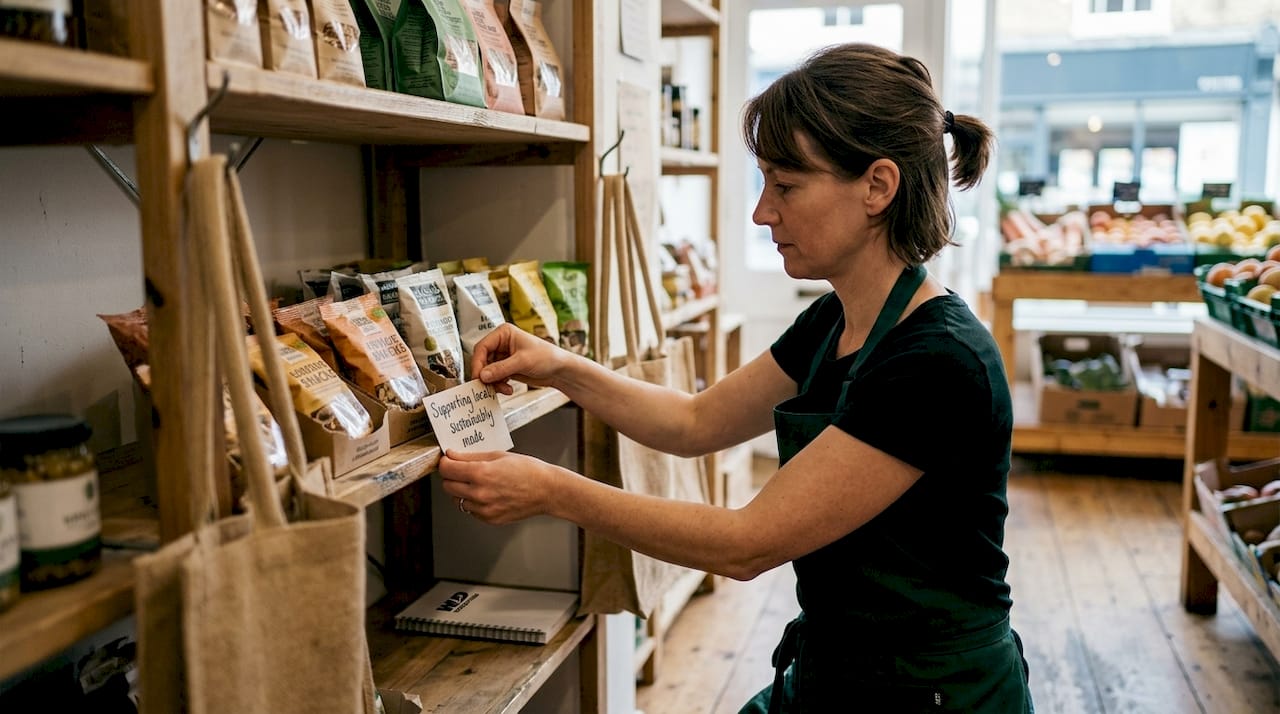
Authentic value-led storytelling distinguishes your brand in crowded categories where functional differences between products often appear minimal. Stories about regenerative farming practices, fair trade relationships, plastic-free packaging, or community impact create memorable brand identities that customers actively seek and recommend. These narratives work particularly well through independent retailers because store owners can share them conversationally, adding personal endorsement that amplifies credibility.
Crafting effective value-led stories requires specificity and proof. Generic claims about caring for the environment or supporting communities lack impact because consumers encounter them constantly. Instead, share concrete details: the specific farm where ingredients originate, the measurable reduction in packaging waste, the exact percentage of profits supporting particular causes. Quantify your impact wherever possible and update these metrics regularly to demonstrate ongoing commitment.
Integrating sustainability messaging throughout your brand presence accelerates acceptance and loyalty:
Design packaging that visually communicates environmental values through material choices and minimal graphics
Include origin stories and sustainability credentials directly on labels where shoppers make purchase decisions
Create digital content showing behind-the-scenes sustainability practices that retailers can share via social media
Develop point-of-sale materials highlighting specific environmental benefits in clear, jargon-free language
Train retail partners on your sustainability story so they can answer customer questions confidently
The business case for sustainability extends beyond consumer preference. Sustainable practices often reduce costs through waste minimisation and efficient resource use. They attract investors and partners who prioritise ethical operations. They future-proof your business against increasing regulatory requirements. Most importantly for acceleration, they create differentiation that commands premium pricing and builds fierce customer loyalty.
“57% of UK shoppers consider sustainability a key purchase factor, making environmental credentials essential for rapid brand growth in today’s food market.”
Authenticity matters more than perfection. Consumers respect brands that acknowledge sustainability challenges whilst demonstrating genuine progress. Share your journey transparently, including obstacles and learnings. This honesty builds trust more effectively than presenting an unrealistically perfect image. Example food brands that communicate openly about their sustainability evolution typically achieve stronger customer connections than those claiming to have solved every environmental challenge.
Comparing brand acceleration approaches: independents vs supermarkets
Choosing your initial distribution channel fundamentally shapes acceleration speed and success probability. Understanding the trade-offs between independent retailers and supermarkets helps you make strategic decisions aligned with your resources and growth objectives.
Factor | Independent retailers | Supermarkets |
|---|---|---|
Speed to market | 2-4 weeks from initial contact to shelf placement | 6-18 months including category reviews and listing processes |
Feedback loop | Immediate and direct from store owners and customers | Delayed and filtered through category managers and sales data |
Financial risk | Lower listing fees and minimum order quantities | High listing fees, promotional contributions, and volume commitments |
Distribution complexity | Manageable through regional wholesalers | Requires sophisticated logistics and multiple distribution centres |
Consumer loyalty | Higher through personal service and curated discovery | Lower due to vast choice and transactional shopping behaviour |
Profit margins | 35-45% typically achievable | 20-30% after promotional funding and listing costs |
Brand storytelling | Rich opportunities through staff interaction and displays | Limited to packaging and occasional promotional features |
Independent retail channels offer faster feedback and agility compared to supermarket distribution, making them ideal for brand acceleration phases. The compressed timeline from product concept to customer feedback allows rapid iteration that would be impossible through supermarket channels where listing decisions occur quarterly at best.
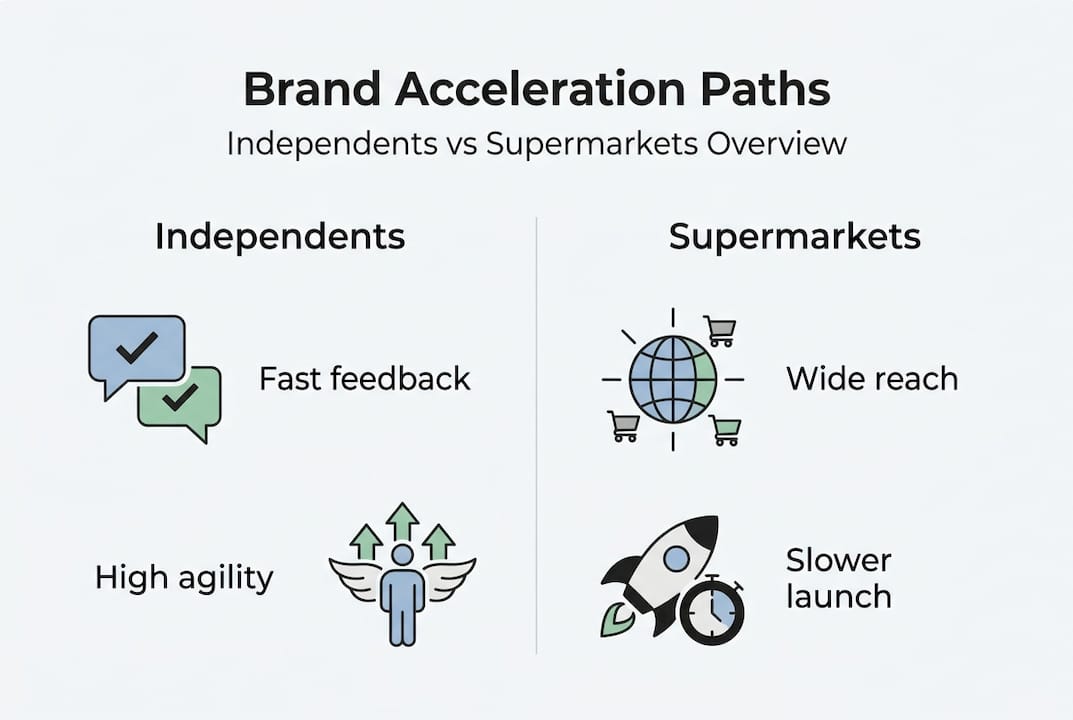
Starting with independents provides crucial advantages for emerging brands. You test product-market fit with manageable financial exposure. You refine your offering based on authentic consumer response before committing to large production runs. You build a track record of sales success that strengthens your position when approaching supermarket buyers. You develop marketing messages and positioning based on real customer language rather than assumptions.
Supermarket distribution makes sense once you have validated your product through independent channels and secured sufficient capital for the associated costs. The volume potential justifies the investment only after you have proven demand, optimised your supply chain, and built brand awareness. Jumping directly to supermarkets risks expensive failure if your product, pricing, or positioning needs adjustment.
Pro tip: Use your first 12 months with independent retailers to document everything: sales velocity by location, customer testimonials, press coverage, social media engagement, and retailer feedback. Compile this evidence into a compelling story that demonstrates proven demand when approaching supermarket category managers. This data-driven approach dramatically increases your listing success rate.
Some brands benefit from a hybrid approach, maintaining strong independent retail presence even after securing supermarket listings. This strategy preserves higher margin sales channels, maintains direct customer relationships, and provides ongoing innovation testing grounds. Retail channel insights show that brands balancing both channels typically achieve more sustainable growth than those abandoning independents entirely after gaining supermarket access.
Accelerate your food brand growth with Woodford
Navigating brand acceleration requires expertise in independent retail dynamics, distribution logistics, and market positioning. Woodford connects visionary food brands with ambitious independent retailers through strategic wholesale services designed specifically for rapid growth. Our trend-led curation ensures your products reach retailers actively seeking innovative offerings that differentiate their stores.
We provide comprehensive brand owner support including market entry strategy, distribution management, and promotional campaign coordination. Our established relationships with hundreds of independent retailers across the UK eliminate the complexity of building individual partnerships whilst maintaining the personal touch that drives sales. We handle logistics, invoicing, and payment security so you can focus on product development and brand building.
Our retailer solutions create the perfect environment for brand acceleration by connecting store owners with products their customers actively seek. We understand the independent retail landscape and tailor our services to support both emerging brands and established retailers pursuing growth. Explore our current promotions to discover how strategic partnerships can accelerate your market presence and drive sustainable revenue growth.
Frequently asked questions
What is brand acceleration in the food industry?
Brand acceleration means strategically compressing the timeline from product launch to market acceptance through focused distribution channels and rapid feedback integration. For food brands, this typically involves launching through independent retailers who provide immediate consumer insights and nimble partnership dynamics. The approach prioritises learning and iteration over perfect initial launches, using real sales data to refine products, positioning, and marketing before scaling to broader distribution.
How can independent retailers help with brand acceleration?
Independent retailers provide direct access to engaged consumers who actively seek novel products and share detailed feedback. Store owners make purchasing decisions quickly without bureaucratic approval processes, allowing brands to reach shelves within weeks rather than months. Their personal customer relationships enable rich storytelling that builds brand loyalty more effectively than supermarket shelf placement. The agility of independent retailers allows brands to test variations, gather authentic responses, and iterate rapidly based on actual purchase behaviour.
Why is sustainability important for brand acceleration?
Sustainability meets the rising consumer demand for ethical products, with 57% of UK shoppers considering environmental credentials essential when making food purchases. Brands with authentic sustainability stories differentiate themselves in crowded categories, command premium pricing, and build fierce customer loyalty. Sustainability credentials also attract retail partners who curate their offerings around values alignment, opening distribution opportunities that price or quality alone cannot secure. In today’s market, sustainability accelerates growth by creating emotional connections that transcend functional product benefits.
What are common pitfalls to avoid in accelerating a food brand?
Skipping initial independent retail launches eliminates the vital feedback loop that prevents costly mistakes at scale. Many brands rush to supermarket distribution before validating product-market fit, resulting in expensive failures and damaged reputations. Neglecting data-driven customer profiling leads to unfocused marketing that wastes resources on wrong audiences. Inauthentic storytelling that relies on generic claims rather than specific, provable values fails to create differentiation. Overextending production and distribution before confirming consistent demand creates cash flow crises that derail promising brands.