How to conduct trend analysis for UK food brands in 2026
Learn practical methods for conducting trend analysis that helps UK food brands align with 2026 consumer priorities in affordability, health, and sustainability.

How to conduct trend analysis for UK food brands in 2026
The UK food market in 2026 presents unprecedented challenges for brand owners and independent retailers. Economic pressures, lifestyle changes, and new expectations around health and sustainability are reshaping consumer behaviour faster than ever before. Understanding these shifts isn’t optional anymore. It’s the difference between thriving and merely surviving. This guide walks you through practical trend analysis methods that help you align your product offerings with what UK consumers actually want, turning market intelligence into competitive advantage.
Table of Contents
Preparing For Trend Analysis: What You Need To Know
Executing Trend Analysis: Steps To Identify And Evaluate Food Market Trends
Common Pitfalls In Trend Analysis And How To Avoid Them
Interpreting And Applying Trend Analysis Insights For Your Food Brand
How Woodford Supports Food Brands With Trend-Driven Growth
Frequently Asked Questions
Key takeaways
Point | Details |
|---|---|
Consumer priorities drive success | Brands must balance affordability, health benefits, and sustainability to meet 2026 UK shopper expectations. |
Insights platforms accelerate decisions | Consumer validation tools reduce product launch risks and strengthen retailer pitches with credible data. |
Economic factors shape behaviour | Inflation and political uncertainty heavily influence purchasing patterns and brand loyalty in 2026. |
Real cases prove methods work | Bells of Lazonby and Yeo Valley demonstrate how consumer insights translate to market success. |
Avoid price-only strategies | Shoppers seek meaningful experiences beyond cost, requiring emotional connection and clear messaging. |
Preparing for trend analysis: what you need to know
Before diving into trend analysis, you need to understand the landscape you’re operating in. The UK food industry in 2026 will be reshaped by economic pressures, lifestyle changes, and new expectations around health and sustainability. These aren’t abstract forces. They’re real factors affecting every purchasing decision your customers make.
The economic picture remains challenging. UK food inflation ended December 2025 at 4.5% year-on-year, meaning consumers are still feeling the pinch at checkout. This creates a paradox: shoppers want quality and values-driven products, but they’re also watching every pound. Your trend analysis must account for this tension.
Political, economic, health, and sustainability factors collectively shape grocery market trends in 2026. Political uncertainty affects supply chains and regulatory environments. Economic pressures force consumers to make trade-offs. Health consciousness has evolved from a niche concern to a mainstream lifestyle driver. Sustainability expectations demand transparency and action, not just green marketing.
Consumers in 2026 prioritise three interconnected values: affordability without compromising quality, health as an integrated lifestyle choice rather than a diet fad, and sustainability that’s simple to understand and verify. They’re savvy enough to spot greenwashing and empty health claims. They want brands that respect their intelligence and their budgets.
Successful trend analysis requires balancing cost considerations with convenience and emotional brand connection. Price alone won’t win loyalty. Neither will premium positioning without clear value. You need to understand where your brand fits in this complex equation.
Before starting your analysis, ensure you have:
Access to current market data covering sales trends, category performance, and competitor activity
Consumer insights tools or partnerships that provide real-time feedback on product concepts
Clear documentation of your sustainability credentials and supply chain transparency
Understanding of health claim regulations and how to communicate benefits without overstepping
Defined target customer segments with detailed demographic and psychographic profiles
Woodford provides support for brand owners navigating these preparatory steps, helping you establish the foundation for effective trend analysis.
Executing trend analysis: steps to identify and evaluate food market trends
Once you’ve established your foundation, follow this structured approach to conduct meaningful trend analysis that informs real business decisions.
Step 1: Gather multi-source consumer data
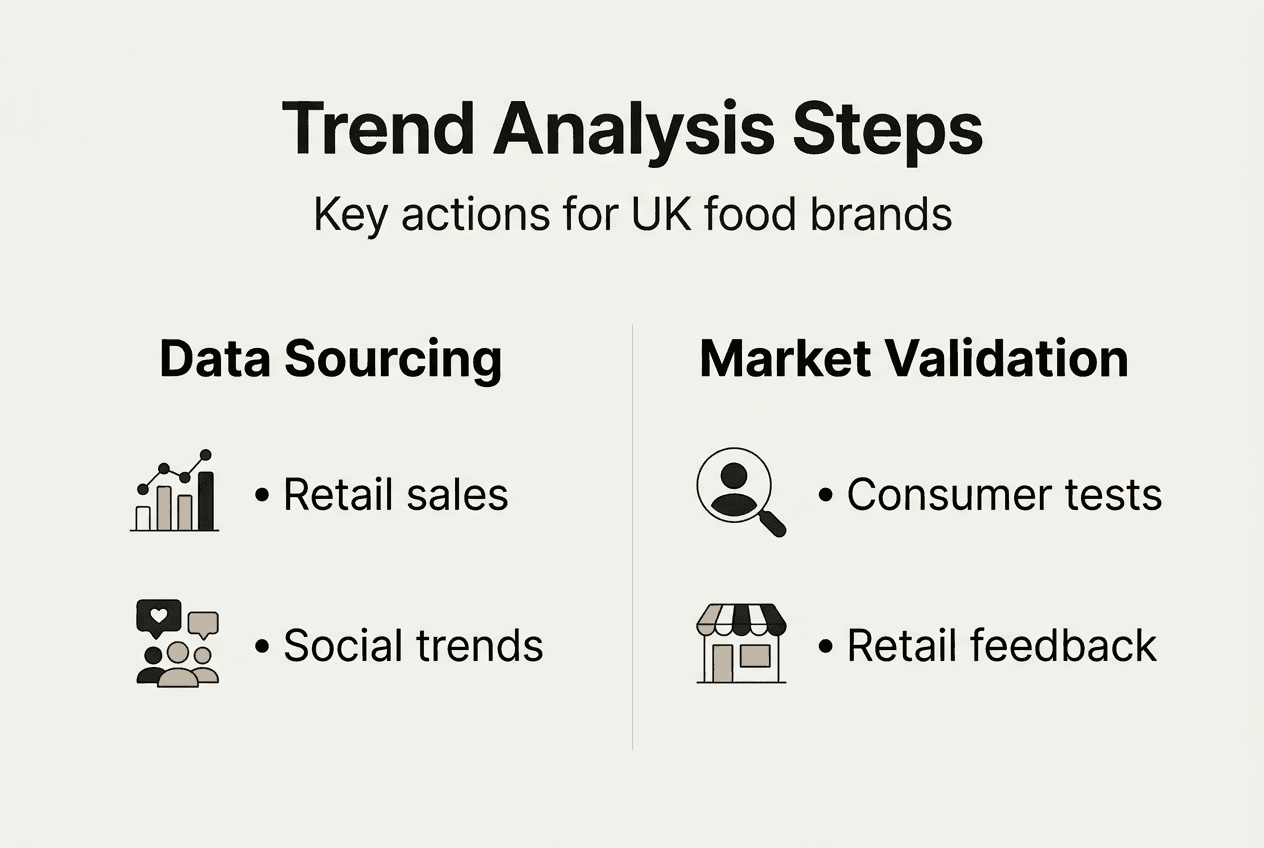
Start by collecting information from diverse sources. Look at retail sales data, social media conversations, search trends, and direct consumer feedback. Focus specifically on the three priority areas: affordability concerns, sustainability expectations, and health preferences. Don’t rely on a single data stream. Cross-reference patterns across multiple sources to identify genuine trends rather than temporary fluctuations.

Step 2: Use consumer insights platforms for rapid analysis
Consumer insights platforms can speed up decision-making and reduce development risk. These tools remove confirmation bias by providing objective validation of your product concepts before you invest heavily in development. They help you understand not just what consumers say they want, but what they actually choose when presented with options.
Bells of Lazonby used this approach to validate new product ideas, gaining confidence in their development pipeline and strengthening their pitches to retailers. The data provided credibility that gut instinct alone couldn’t match.
Step 3: Validate concepts with retail partners
Consumer insights enable clearer product-market fit backed by validation. Once you’ve identified promising trends and developed concepts, test them with your retail partners. Share the consumer data supporting your ideas. Retailers appreciate brands that arrive with evidence rather than hopeful assumptions.
Yeo Valley exemplifies this approach, using consumer validation to refine their product development and ensure alignment with shopper priorities. This collaborative validation reduces the risk of costly misalignments between brand vision and market reality.
Step 4: Adjust messaging based on feedback
Consumer language matters enormously. You might discover that ‘free range’ resonates more powerfully than ‘grass-fed’ for your target audience, or that ‘plant-based’ outperforms ‘vegan’ in certain contexts. These nuances can make or break product success. Use your trend analysis to optimise not just what you offer, but how you communicate it.
Explore Woodford’s product innovation showcase and brand case studies to see how successful brands have applied these principles.
Pro tip: Leverage consumer insights platforms early in your product development cycle, not as a final validation step. This approach transforms insights from a checkpoint into a strategic advantage, allowing you to pivot quickly and confidently while competitors are still guessing.
Analysis stage | Key actions | Expected outcomes |
|---|---|---|
Data gathering | Collect sales data, social listening, search trends, direct feedback | Comprehensive view of consumer behaviour patterns |
Platform analysis | Use insights tools to validate concepts and remove bias | Objective product-market fit assessment |
Retail validation | Share consumer data with retail partners | Stronger buyer confidence and shelf placement |
Messaging refinement | Test language and positioning with target audiences | Optimised communication that drives conversion |
Common pitfalls in trend analysis and how to avoid them
Even experienced brand owners fall into predictable traps when analysing market trends. Recognising these pitfalls helps you avoid wasting time and resources on flawed strategies.
The biggest mistake is focusing solely on price. Yes, consumers are cost-conscious in 2026. But savvy shoppers balance value with experience, health, and sustainability. If you compete only on price, you’re in a race to the bottom that erodes margins and brand equity. Consumers want meaningful experiences and products that align with their values, not just the cheapest option.
Many brands also neglect clarity around sustainability and health claims. Vague statements like ‘better for you’ or ‘eco-friendly’ don’t cut it anymore. Consumers demand specifics. What makes it better? How is it eco-friendly? If you can’t answer these questions simply and credibly, your claims will backfire.
Skipping consumer validation is another costly error. You might believe your product idea is brilliant, but without real consumer feedback, you’re gambling with development budgets and retail relationships. Every pound spent on unvalidated concepts is a pound you could have invested in proven winners.
Retailers and brands need to balance cost and convenience with clarity, resilience, and emotional connection to succeed in 2026. The brands that win are those that understand consumers want more than transactions. They want relationships with brands that reflect their values and respect their intelligence.
Avoid these common errors by:
Testing product concepts with real consumers before committing to full development
Providing specific, verifiable claims about health benefits and sustainability credentials
Building emotional connection through authentic brand storytelling, not just functional benefits
Monitoring competitor moves without blindly copying their strategies
Maintaining agility to pivot when trend analysis reveals unexpected insights
Investing in ongoing consumer research rather than one-off studies
Woodford offers guidance for food brand owners to navigate these challenges and build resilient, consumer-led strategies.
Interpreting and applying trend analysis insights for your food brand
Collecting trend data is only valuable if you can translate it into actionable strategy. Here’s how to turn insights into competitive advantage.
Traditional approach | Consumer-led approach |
|---|---|
Develop products based on internal assumptions | Validate concepts with real consumer data before development |
Launch and hope for retailer acceptance | Pitch with consumer insights that prove demand |
React to competitor moves | Anticipate trends and lead category innovation |
Generic sustainability messaging | Specific, verified claims that build trust |
Focus on product features | Emphasise emotional connection and lifestyle fit |
Start by refining your product formulations to reflect health and sustainability priorities identified in your analysis. If consumers in your target segment prioritise reduced sugar but won’t compromise on taste, your formulation strategy needs to solve that specific challenge. If they value local sourcing, your supply chain becomes a marketing asset.
Your messaging must evolve alongside your products. Brands need to balance cost and convenience with clarity, resilience, and emotional connection to succeed in 2026. This means your marketing can’t just list features. It needs to tell a story that resonates emotionally while providing the practical information consumers need to make confident choices.
Pro tip: Embed consumer-led decision-making into your ongoing new product development process, not just major launches. Create a rhythm of continuous consumer feedback that informs incremental improvements and line extensions. This agility allows you to stay ahead of trends rather than chasing them.
Emotional connection in marketing stems from understanding what your consumers truly value. If your trend analysis reveals that your target audience sees food choices as expressions of identity and values, your brand story should reflect that significance. If they view cooking as a creative outlet, position your products as enablers of that creativity.
Expect these results from properly applied trend analysis:
Improved product-market fit leading to stronger initial sales and repeat purchases
More successful retailer pitches backed by consumer validation data
Reduced development waste from concepts that wouldn’t have succeeded
Enhanced consumer loyalty through products that genuinely meet their needs
Competitive differentiation based on deep consumer understanding
Woodford provides strategic support for brand owners looking to implement these consumer-led approaches and translate trend insights into market success.
How Woodford supports food brands with trend-driven growth
Navigating the complex UK food market in 2026 requires more than good products. It demands strategic partnerships that understand both consumer trends and retail dynamics.
Woodford specialises in helping food brands leverage market insights and consumer trends to achieve sustainable growth. We bridge the gap between visionary food brands and ambitious independent retailers through exclusive distribution, trend-led curation, and hassle-free logistics. Our team stays ahead of market shifts, ensuring the brands we work with are positioned to meet evolving consumer demands.
We help brands innovate with confidence by connecting them to the right retail partners and providing the market intelligence needed to make informed decisions. Whether you’re launching a new product line or refining your existing portfolio, our expertise in UK food retail trends gives you a competitive edge.
Explore how Woodford supports brand owners, discover our diverse brand portfolio, and check out current promotional opportunities to accelerate your growth in 2026.
Frequently asked questions
What is trend analysis for food brands?
Trend analysis involves systematically studying market data, consumer behaviour, and societal changes to predict future preferences and purchasing patterns. For food brands, this means identifying shifts in health priorities, sustainability expectations, affordability concerns, and lifestyle choices that influence product development and marketing strategies. It transforms scattered information into actionable intelligence that reduces risk and improves decision-making.
How can consumer insights platforms benefit my food brand?
Consumer insights platforms can speed up decision-making and reduce development risk by providing rapid validation of product ideas with real consumer data. They remove confirmation bias and gut-feel decision-making, replacing them with objective evidence of what consumers actually want. This credibility strengthens your pitches to retailers and ensures you’re investing development resources in concepts with proven market potential.
What are the biggest 2026 food retail trends in the UK?
The UK food industry in 2026 will be reshaped by economic pressures, lifestyle changes, and new expectations around health and sustainability. Affordability remains critical, but consumers won’t sacrifice quality or values for price alone. Health has evolved from a diet concern to a lifestyle driver, with consumers seeking products that support overall wellbeing. Sustainability expectations demand simplicity and transparency, with shoppers favouring brands that communicate their credentials clearly.
How often should I conduct trend analysis for my food brand?
Trend analysis shouldn’t be a one-off exercise but an ongoing process integrated into your business rhythm. Conduct comprehensive analysis quarterly to identify major shifts, with monthly check-ins on key metrics and consumer sentiment. This regular cadence allows you to spot emerging trends early and pivot quickly when market conditions change. The brands that succeed in 2026 are those that maintain continuous consumer connection rather than periodic research projects.
What’s the difference between a trend and a fad in food retail?
Trends represent fundamental shifts in consumer values, behaviour, or expectations that persist over time and influence multiple product categories. Fads are temporary spikes in interest that fade quickly without leaving lasting impact. Distinguish between them by examining whether the pattern connects to deeper societal changes, appears across multiple data sources, and shows sustained growth rather than a sudden spike. True trends align with evolving consumer priorities like health, sustainability, or convenience, while fads often stem from novelty or social media buzz without substantive value propositions.